How a Founder Can Save Millions in Taxes With the Right Formation Sequence
The Startup Founder’s Formation to Exit Tax Playbook is an 18-page, plain-English walkthrough of entity choice, founder stock, the 83(b) election, and QSBS eligibility — written for founders, not lawyers, and sourced to the actual statutes, regulations, and IRS forms.
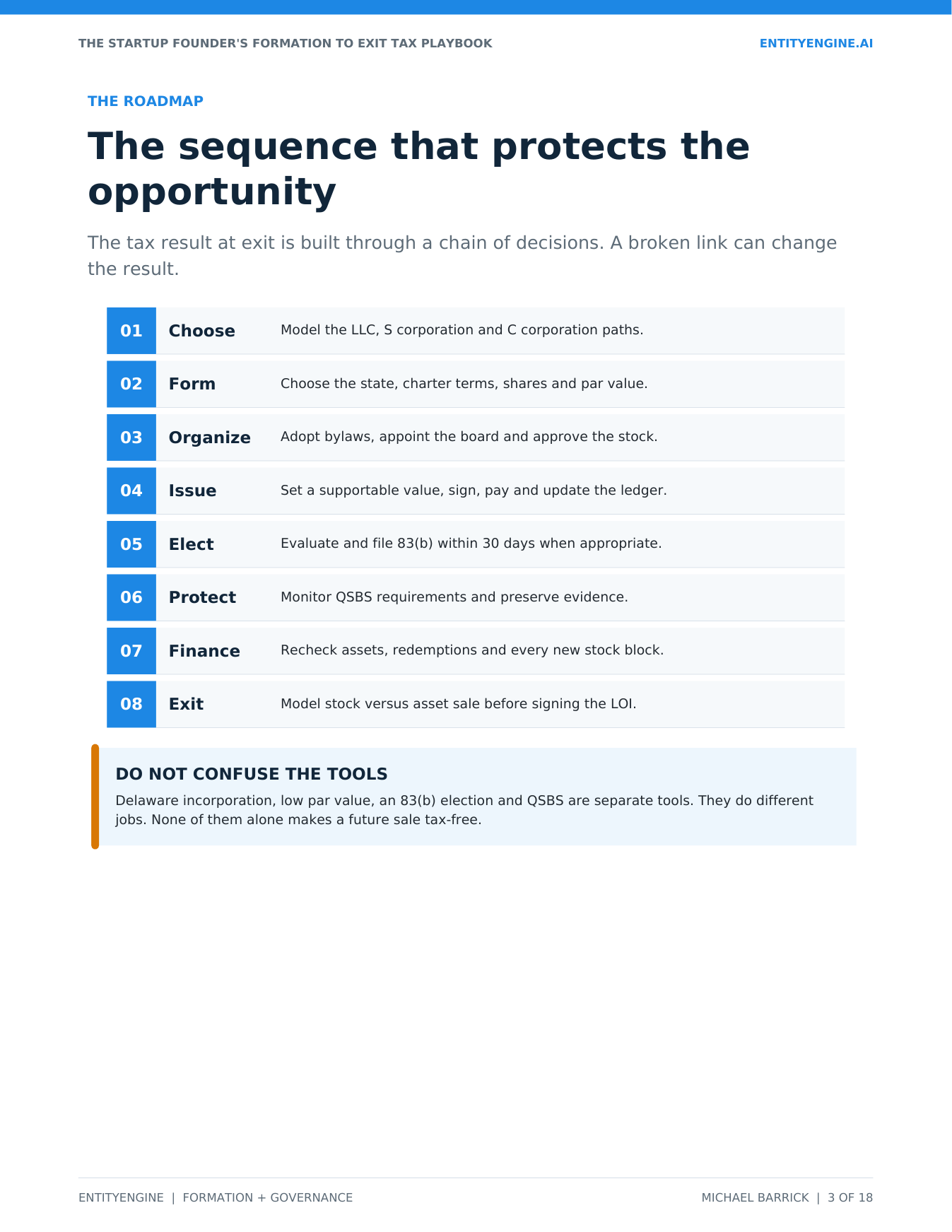
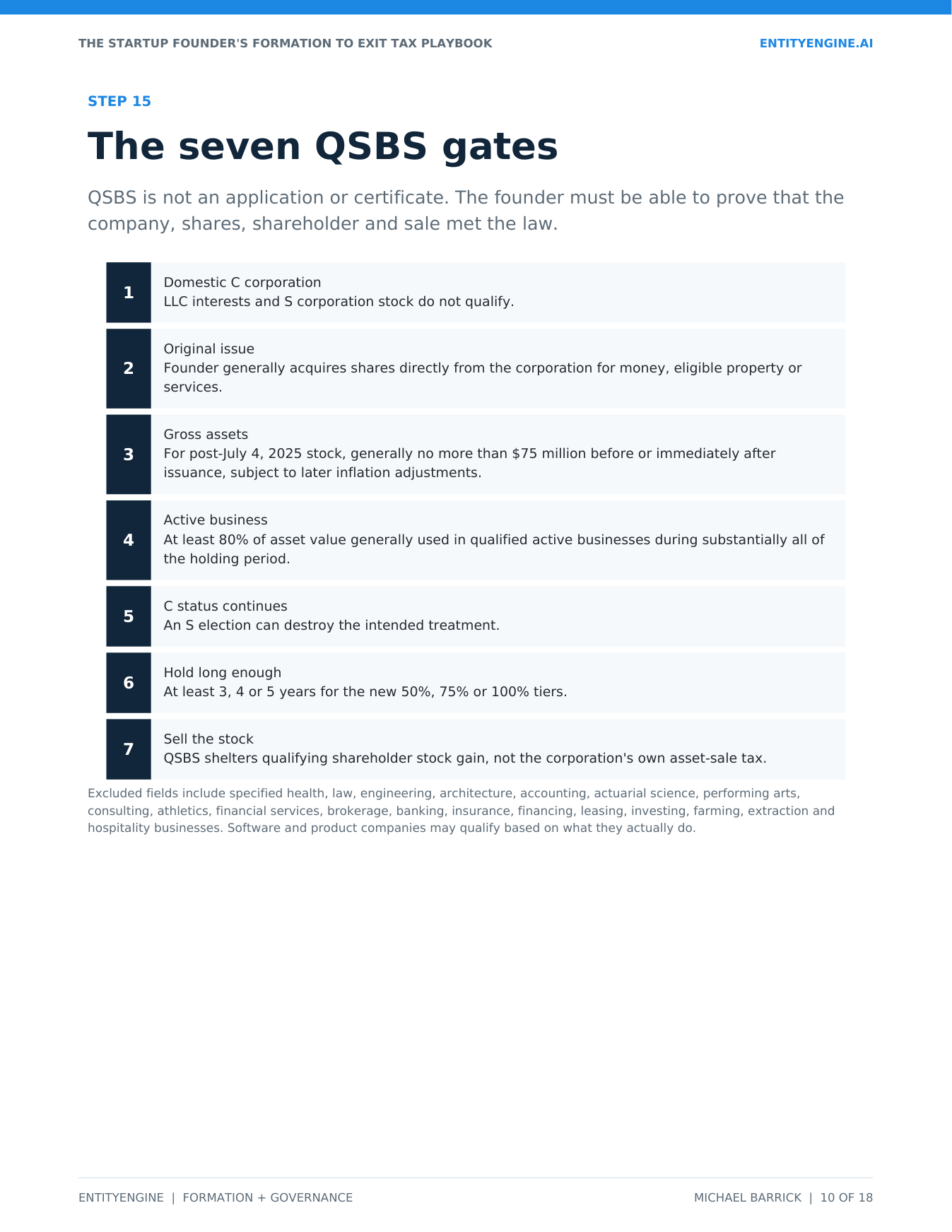
Inside: The 28 Steps Between Formation and a Tax-Smart Exit That Could Save You Millions in Taxes
- The 28-step sequence from entity choice to exit — and why one broken link (a backdated document, a missed election, a careless redemption) can change the result.
- The seven QSBS gates, in order, with the excluded-business list and the “silent disqualifiers” most founders have never heard of.
- The 83(b) deadline page: IRS Form 15620, why to treat the 30-day window as a 10-day task, and the exact proof package to keep forever.
- The post-July 4, 2025 numbers: the new 3-, 4-, and 5-year tiers (50% / 75% / 100% exclusion), the $75M gross-asset limit, and the $15M per-taxpayer cap.
- The Delaware-or-your-state decision — what Delaware actually buys you, what it doesn’t, and what a Delaware company operating elsewhere still owes at home.
- A worked example: a Florida founder forms a Delaware C corp in August 2026 and sells for $10M — the full timeline, checkpoint by checkpoint.
Ends with a one-page, day-one execution checklist to take into your first counsel meeting.
For
Founders who haven’t formed yet, or formed in the last year or two and want to check the record. Solo founders choosing between an LLC and a C corp. Founders heading toward angels or venture capital.
Not for
Founders looking for a way around hiring a lawyer or CPA. The playbook exists to make that engagement shorter, cheaper, and better-documented — not to replace it.
Free. Emailed in about a minute. Current through August 7, 2026.
Questions founders ask
Is this legal or tax advice?
No. It’s a planning tool. It gives you the sequence of questions, documents, and deadlines to take to a qualified startup lawyer and tax adviser. Don’t form, issue stock, or file an 83(b) from a PDF alone — ours or anyone’s.
Is it current?
The edition on this page is current through August 7, 2026, and reflects the July 2025 QSBS changes — the new $15M per-taxpayer cap, the $75M gross-asset limit, and the 3-, 4-, and 5-year holding tiers. When the law moves, we re-issue and re-date it.
What does it cost?
Nothing. You give us an email address; we send the playbook. That’s the trade, stated plainly.
What will you do with my email?
Send the playbook. Marketing email is separate and only happens if you tick the optional consent box, with unsubscribe on every email. We don’t sell or share addresses.
Do I need to be a Delaware C corp for this to matter?
No — the first third of the playbook is about deciding whether a C corp is even right for you. LLC and S corp paths are covered, including when not to chase QSBS.
Sourced to primary law
IRC §1202 · IRC §1045 · IRC §83 · Treas. Reg. 1.83-2 · P.L. 119-21 §70431 (2025 QSBS expansion) · IRS Form 15620 · IRS Pub. 550 · DGCL §153
Every claim in the playbook is cited to the statute, regulation, or official IRS form behind it — 21 primary sources, verified for this edition.
EntityEngine is a formation and governance company. It is not a law firm, accounting firm, tax adviser, broker, or investment adviser, and it cannot guarantee QSBS treatment or any tax outcome. This page and the playbook are educational. Tax results depend on the corporation, shareholder, stock issuance, holding period, transaction structure, state residency, and documentation, and laws can change after publication.