Most organizations lose performance between the board's decision and the staff's work
Every board has lived this. A motion passes, the minutes get filed, and three months later someone asks, "Didn't we decide that already?" Nobody can say who owned it or how far it got. The decision was made. It just never became work.
After years of building Board Director and training directors through the Board Director Institute, I have come to see that handoff as the place where governance pays off or doesn't. This article explains how we close it in EntityEngine, how we keep board records secure while doing it, and how we measure whether it works.
Why do board decisions get lost?
Board decisions get lost because the board and the staff work in different tools. The board records a decision in the minutes. The staff work from email, project tools and spreadsheets. Nothing connects the two, so the decision and the work drift apart.
| Tool | What it does well | What it misses |
|---|---|---|
| Board portal | Meetings, board books, voting, minutes | What happens after the vote |
| Project tool | Tasks, owners, due dates | Why the work exists and who approved it |
| Shared drive | Storing documents | Which document matters, and to whom |
| Compliance spreadsheet | Listing deadlines | The people and decisions behind each deadline |
The problem is not a missing tool. It is the missing link between the tools.
An AI operating system for boards connects decisions to the work they create
An AI operating system for boards is one system that connects the board's records, decisions and follow-up work, and uses AI to help people find and act on them. Think of it as the organization's second brain: it remembers what the board decided and did, and shows what needs to happen next.
- Decision Vault: every motion, vote and resolution, with the supporting papers.
- Discussions: conversations attached to the meeting or decision they belong to, not lost in email.
- News: updates for the board and the team, and each person sees only what is meant for them.
- Projects and Tasks: the work each decision creates, with an owner and a due date.
The Decision Engine records the decision. The same system also handles company formation, compliance tracking, cap tables and governance training, so the organization's records start in one place and stay there.
Mission Control works like a chief of staff for every director
Mission Control is the screen that brings all of this together for each person. It works like a chief of staff: it sorts what needs your attention so you do not have to go looking. A director sees pending votes, assigned tasks, upcoming meetings and approaching deadlines, and each item links back to the decision, document or discussion behind it.
How a decision travels from the board to the staff
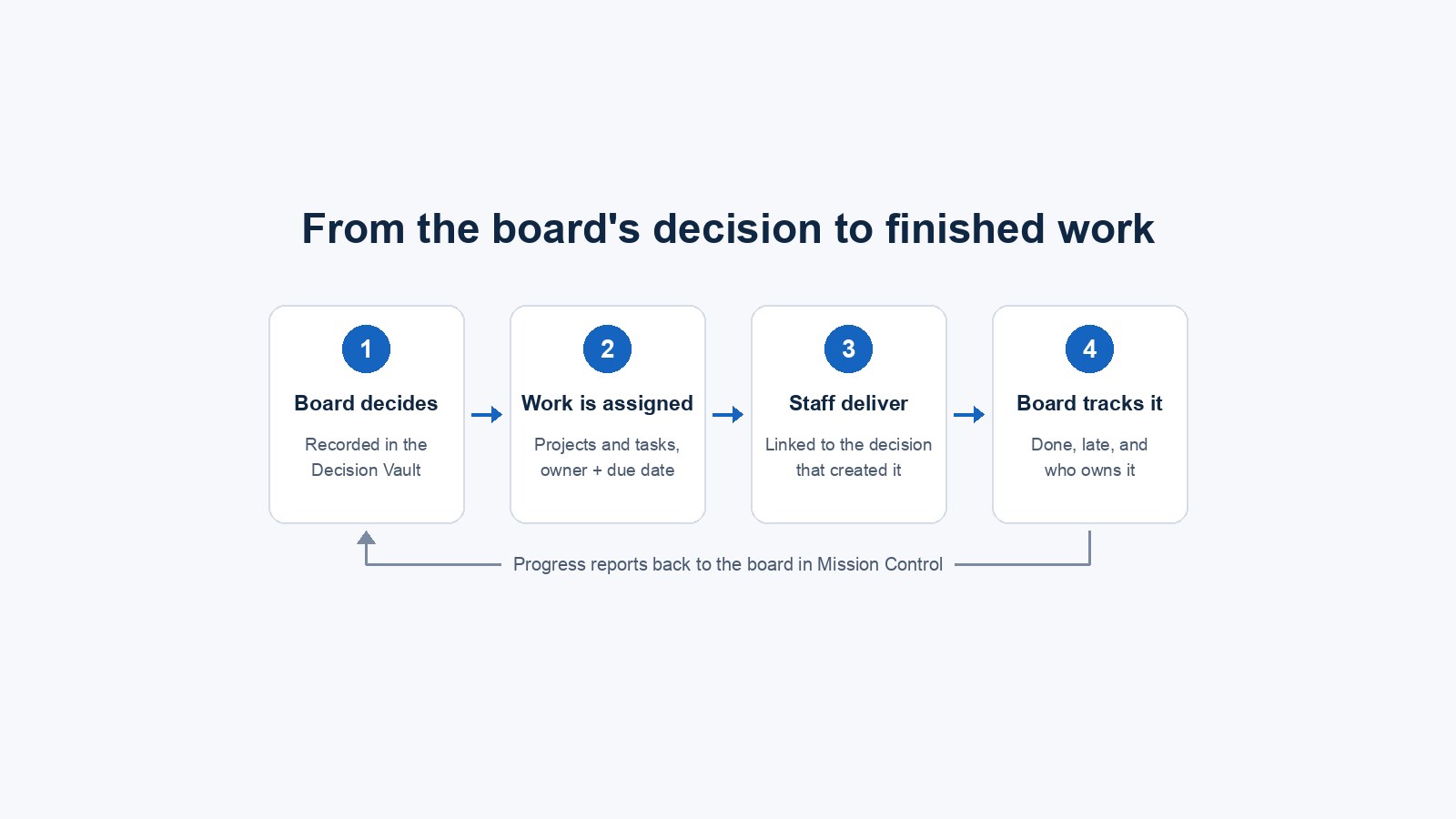
- The board votes, and the decision is recorded in the Decision Vault.
- The decision becomes a project or tasks for staff, each with an owner and a due date.
- Staff see the work in their own Mission Control, linked to the decision that created it.
- Progress reports back, so the board can see what is done, what is late and who owns it.
A decision is not finished when the vote passes. It is finished when the work is done, and the board can see that it was.
Ask Max answers questions about your organization from your own records
Ask Max is EntityEngine's AI assistant. It answers questions about your organization only from your organization's own records. Everything the board and staff add, such as minutes, decisions, documents and discussions, goes into a private library for that organization alone. Max looks things up there before it answers, the way a good company secretary checks the files.
This approach, called retrieval-augmented generation, grounds an AI's answer in specific source material instead of the model's general memory. Max is built not to guess: each answer points to its source in the company's records, so directors can check it themselves. You can read more about how EntityMax works.
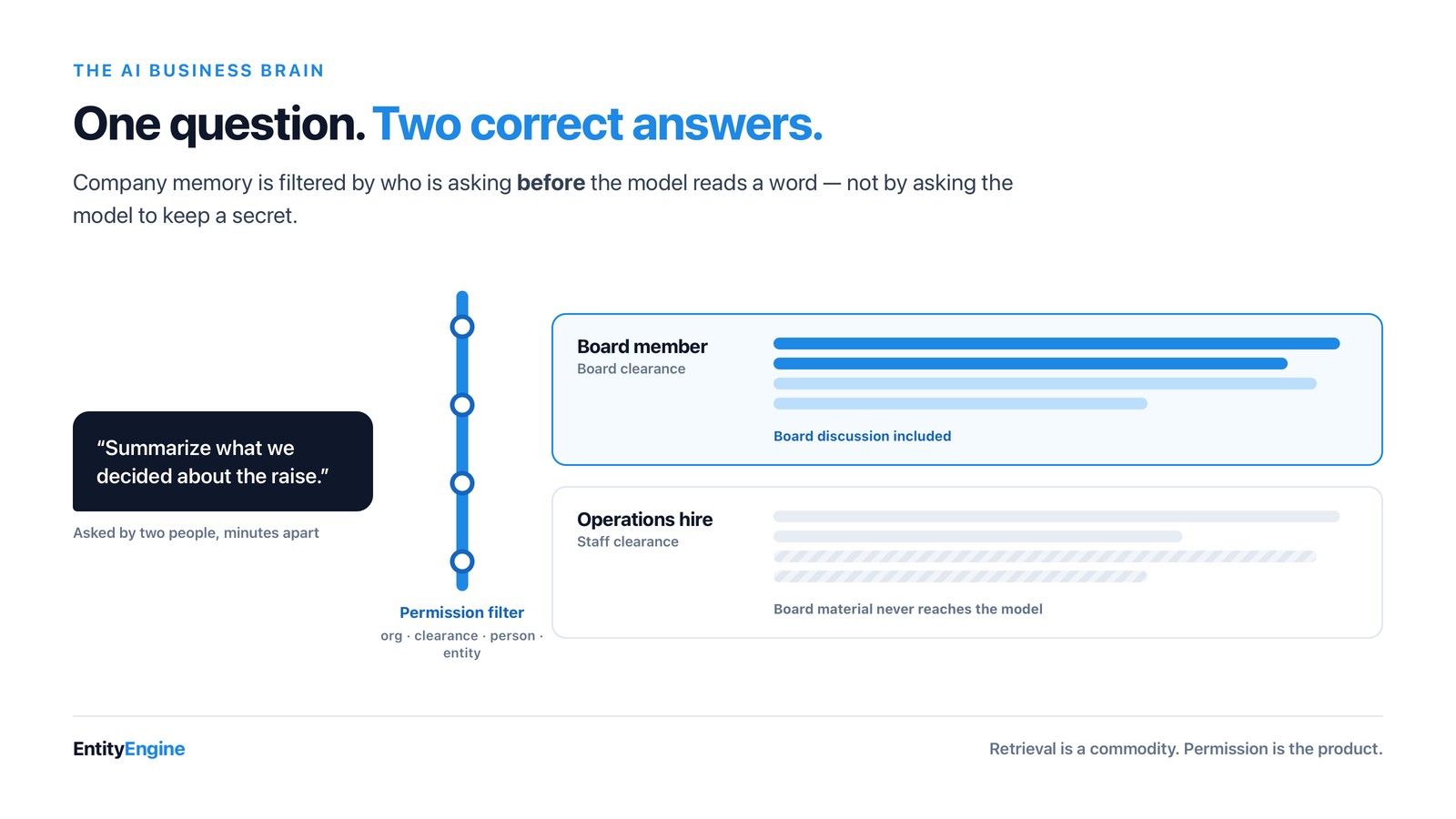
Max also respects permissions. A director, a staff member and a guest asking the same question get different answers based on what each is allowed to see. A director can ask, "What did we decide about this last year?" and get the decision, the date and the supporting record instead of searching old minutes.
Board records need security that matches how sensitive they are
Board decisions are among an organization's most sensitive records, so we protect them that way:
- Each organization's data is kept completely separate and encrypted.
- Every upload is scanned for viruses.
- Confidential files need a fresh code to open.
- Max sees only what each person is permitted to see.
- The board, not the AI, makes every decision. Max finds information and drafts. People approve.
See security and data handling for more detail.
Judge any board system by outcomes leaders can see
Any AI tool for organizations should be judged by measurable outcomes, not by its feature list. These are the measures we use:
| Measure | What it shows |
|---|---|
| Decisions carried out | How many board decisions turn into finished work, and how fast |
| Time saved | Hours no longer spent hunting for documents, decisions and answers |
| Fewer missed obligations | Filings and compliance deadlines met on time |
| Less tool sprawl | One system in place of a board portal, project tool, drive and spreadsheet |
We are building these measures into the product, so each organization can see its own numbers rather than take our word for it.