How a Founder Could Legally Pay $0 in Federal Income Tax on a $10 Million Startup Sale
Verified against current federal and state sources as of August 7, 2026
A founder sells a software company for $10 million.
One founder could owe more than $2 million in federal taxes. Another could potentially owe $0 in federal income tax on the qualifying gain.
The difference may come down to decisions made years before the buyer ever appeared.
That comparison assumes a sale producing approximately $10 million of gain, a founder in the highest applicable capital gain bracket and no other special exclusion. Sale price and taxable gain are not always the same. Tax basis, transaction expenses and deal structure can change the result.
One of the most important decisions is whether the founder receives Qualified Small Business Stock, commonly called QSBS.
QSBS is one of the most valuable federal tax benefits available to qualifying startup founders. It can allow a founder to exclude part or all of the gain from selling qualifying C corporation shares.
But QSBS is not automatic. You cannot create it by changing the company’s paperwork the week before a sale. The company, the shares, the founder and the transaction must satisfy detailed rules over several years.
Founders take the risk and spend years creating the value. When they finally achieve the exit they dreamed about, I want them to keep as much of that value as legally possible. For qualifying founders, QSBS can be worth millions.
Here is what every startup founder should understand.
What is QSBS?
QSBS stands for Qualified Small Business Stock.
Section 1202 of the Internal Revenue Code allows a taxpayer other than a corporation to exclude qualifying gain from the sale or exchange of QSBS.
In plain English: if you receive the right stock from the right type of company, hold it long enough and satisfy the other rules, the federal government may let you keep some or all of the gain without paying federal income tax on it.
For qualifying shares acquired after July 4, 2025, the exclusion depends on how long the shares are held:
| Holding period | Potential exclusion | Potentially excluded on $10M gain |
|---|---|---|
| At least 3 years | 50% | $5,000,000 |
| At least 4 years | 75% | $7,500,000 |
| At least 5 years | 100% | $10,000,000 |
Simplified example for shares acquired after July 4, 2025. Actual exclusion depends on the full Section 1202 requirements, per-issuer limits, basis, acquisition date and other facts. Source: 26 U.S.C. Section 1202 and Section 70431 of Public Law 119-21.
The current law is in Internal Revenue Code Section 1202. Congress added the newer three, four and five year schedule through Section 70431 of Public Law 119-21, enacted July 4, 2025.
The taxable part of a partial QSBS exclusion does not simply fall into the normal 20% long term capital gain bucket. The IRS treats eligible QSBS gain remaining after the Section 1202 exclusion as 28% rate gain. A 3.8% Net Investment Income Tax may also apply to the taxable portion, depending on the founder's income and circumstances. See IRS Publication 550 and the IRS Net Investment Income Tax guidance.
Using a $10 million qualifying gain as the example, the simplified federal tax difference can look like this:
| Scenario | Taxable gain | Approx. federal tax | Potential savings |
|---|---|---|---|
| No QSBS exclusion | $10,000,000 | $2,380,000 | Baseline |
| At least 3 years | $5,000,000 | $1,590,000 | $790,000 |
| At least 4 years | $2,500,000 | $795,000 | $1,585,000 |
| At least 5 years | $0 | $0 | $2,380,000 |
Illustrative federal-only calculation. It assumes $10,000,000 of qualifying gain, no basis or transaction-cost adjustment, no state tax, no other limitations, no AMT effect for post-July 4, 2025 stock, a 20% long-term capital gain rate plus possible 3.8% NIIT for the no-QSBS baseline, and a 28% rate plus possible 3.8% NIIT on the taxable part of a partial QSBS exclusion. Sources: IRS Publication 550, IRS Net Investment Income Tax guidance, 26 U.S.C. Section 1(h)(7), 26 U.S.C. Section 1202 and Public Law 119-21.
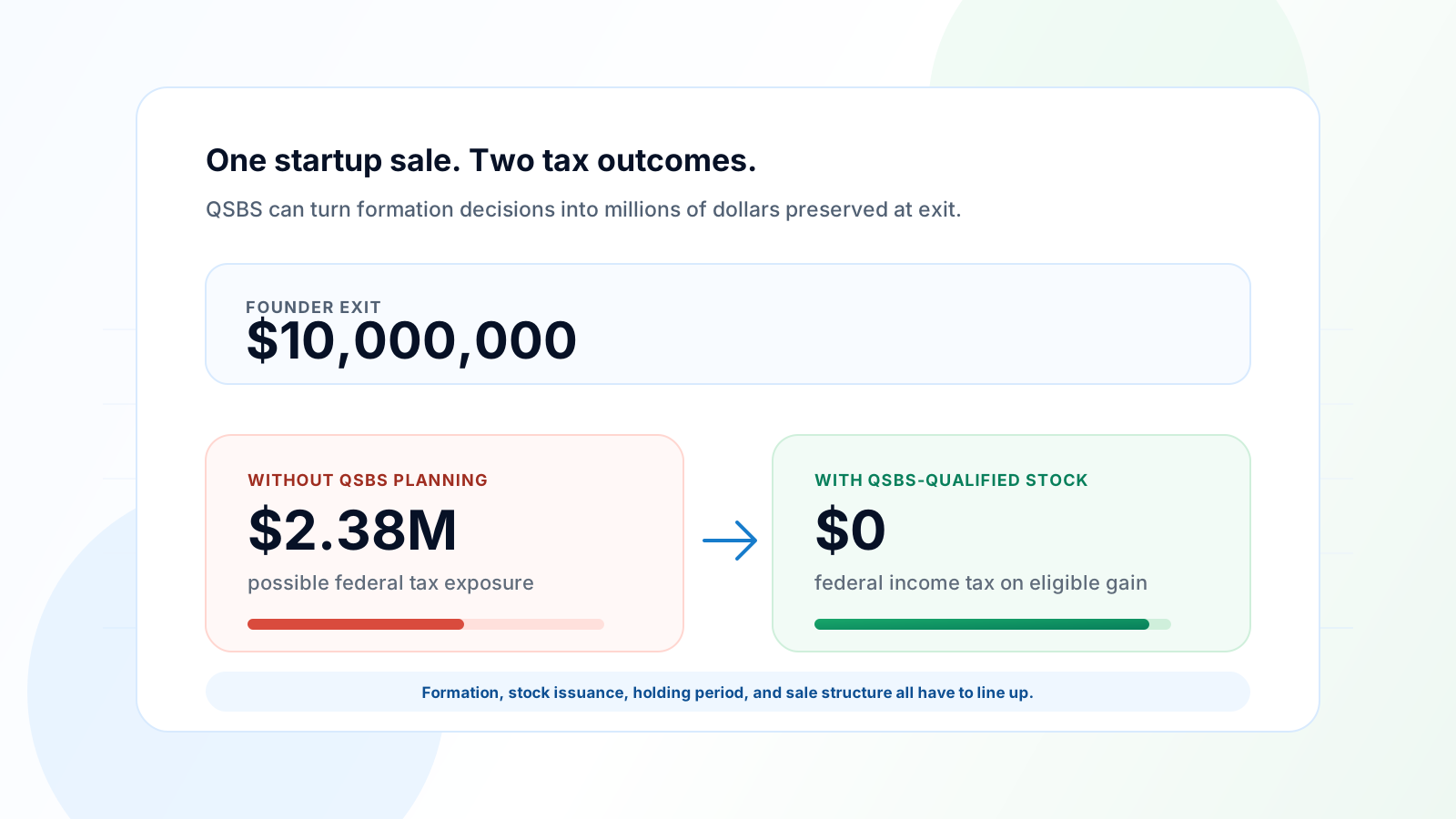
These simplified dollar amounts do not account for state tax, basis, the exclusion cap, other capital gains and losses or the taxpayer's regular tax calculation.
What about the Alternative Minimum Tax?
Early commentary on the 2025 law was inconsistent, but the enacted statute is clearer. Public Law 119-21 amended Section 57(a)(7) so the 7% QSBS preference item applies only to stock acquired on or before September 27, 2010. Under the current enacted text, the new 50%, 75% and 100% tiers for stock acquired after July 4, 2025 are not subject to that 7% preference item. See 26 U.S.C. Section 57(a)(7) and Section 70431(a)(4) of Public Law 119-21.
For qualifying stock acquired after July 4, 2025, the exclusion limit is generally the greater of:
- A $15 million per taxpayer, per issuer limit, reduced by qualifying gain previously used against that limit, or
- Ten times the aggregate adjusted basis of the qualifying shares sold during the year.
For married taxpayers filing separately, the post July 4, 2025 dollar limit is $7.5 million. The $15 million amount is scheduled to receive inflation adjustments for tax years beginning after 2026.
Stock acquired on or before July 4, 2025 remains under the older rules: a $10 million dollar limit, a $50 million gross asset ceiling and no exclusion unless the stock is held for more than five years. Founders with stock issued in multiple rounds may therefore have separate blocks governed by different acquisition dates, limits and holding rules. Those blocks should be tracked separately. Applying the exclusion percentages and per issuer limitations across mixed blocks can be complex and should be reviewed by a Section 1202 specialist.
This means that a founder who receives qualifying shares after July 4, 2025, holds them for at least five years and later sells those shares for $10 million could potentially exclude the entire qualifying gain from federal gross income.
That is possible. It is not guaranteed.
Delaware vs. your home state: what actually matters
QSBS is a federal tax rule. Delaware incorporation is not required.
A qualifying Florida C corporation can issue QSBS. A qualifying Delaware C corporation can also issue QSBS. The state named on the certificate of incorporation does not create the exclusion.
Delaware is often chosen because institutional investors and their attorneys are familiar with Delaware corporate law. If a Delaware corporation is principally operating in Florida, it will generally also need to qualify as a foreign corporation in Florida. That means maintaining the Delaware corporation while also handling Florida registration, annual reports and other applicable Florida obligations. Florida provides the relevant foreign corporation forms.
Delaware corporations also file an annual report and pay Delaware franchise tax. Delaware explains the two calculation methods in its franchise tax guidance. A low par value can affect corporate law and franchise tax calculations, but it does not create the federal QSBS exclusion and does not reduce taxable gain at sale.
If a founder expects a seed or Series A financing, a Delaware C corporation is often the practical starting structure. If the founder does not expect institutional investment, plans to distribute profits or expects a future asset sale, an LLC may be more tax efficient during operations. Those are planning considerations, not universal rules.
The seven basic requirements founders need to understand
QSBS contains technical rules, exceptions and special situations. At a basic level, founders should focus on these requirements.
1The company must be a domestic C corporation
An ordinary LLC interest is not QSBS. S corporation stock is not QSBS.
The issuing company must be a domestic C corporation. It does not have to be incorporated in Delaware. A qualifying Florida C corporation can also issue QSBS.
The domestic C corporation and original issue requirements come directly from Sections 1202(c)(1) and 1202(d)(1).
2Founder shares must be original issue
The founder generally must acquire original issue shares directly from the corporation in exchange for money or other property, not including stock, or as compensation for services.
Buying existing shares from another founder usually does not satisfy the original issue requirement, although special rules can apply to gifts, inheritances and certain reorganizations.
Founders also need to watch the anti churning rules for stock redemptions. Subject to detailed exceptions, stock can be disqualified if the corporation buys stock from the taxpayer or a related person during the four year period beginning two years before the issuance. A significant corporate redemption exceeding the statutory 5% threshold during the two year period beginning one year before the issuance can also taint stock issued during that window. See Section 1202(c)(3).
3The corporation must satisfy the gross assets test
For shares issued after July 4, 2025, the corporation generally cannot have aggregate gross assets exceeding $75 million before or immediately after the share issuance. The amount received in the issuance counts in the test.
The current statutory threshold and the treatment of contributed property appear in Sections 1202(d)(1) and 1202(d)(2). Different rules apply to shares issued on or before July 4, 2025.
4The company must conduct an eligible active business
During substantially all of the shareholder's holding period, at least 80% of the value of the corporation's assets generally must be used in one or more qualified active businesses.
Many product and software companies may qualify, depending on what the company actually does. The law excludes services in health, law, engineering, architecture, accounting, actuarial science, performing arts, consulting, athletics, financial services and brokerage services, as well as businesses whose principal asset is the reputation or skill of employees. It also excludes banking, insurance, financing, leasing, investing, farming, certain mining and extraction businesses, hotels, motels, restaurants and similar businesses.
The 80% test has additional rules. Reasonably required working capital and funds expected to be used within two years for research or working capital can count as active business assets, subject to a limitation after the corporation has existed for two years. A corporation can also fail the test when more than 10% of its asset value consists of real property not used in the active business. Computer software producing qualifying active business royalties receives special treatment.
The complete statutory requirements and excluded categories appear in Section 1202.
5The company generally must remain a C corporation
The corporation generally must remain a C corporation during substantially all of the founder's holding period. An S corporation election can destroy the intended QSBS treatment.
6The founder must hold the shares long enough
For shares acquired after July 4, 2025, the first potential exclusion begins when the shares have been held for at least three years. The full 100% exclusion requires at least five years. For older stock acquired on or before July 4, 2025, the statute instead requires more than five years. The acquisition date and exact closing date therefore matter.
Starting as an LLC and converting later creates a larger trap than simply restarting the clock. When property other than money or stock is contributed to a corporation for shares, Section 1202 generally treats the shares as acquired on the exchange date and treats their basis for Section 1202 purposes as no less than the property's fair market value. As a practical result, appreciation already built into an LLC's assets before conversion generally is not eligible QSBS gain, even though that built in appreciation can still be taxable when the shares are sold. The fair market value basis can also affect the ten times basis limitation. See Section 1202(i)(1).
Founders should obtain tax advice before moving an existing business or valuable intellectual property into a corporation.
7The founder must sell the shares
QSBS applies to qualifying shareholder gain from selling or exchanging the stock. It does not shelter the C corporation's own gain when the corporation sells its software, customer contracts and other assets.
That difference is critical.
Stock sale versus asset sale
Founders often say, “I sold my company,” but that can describe two very different transactions.
In a stock sale
The buyer purchases the founder's shares. The corporation continues owning its software, contracts, intellectual property and other assets.
If the shares qualify as QSBS and every other requirement is satisfied, the founder may claim the Section 1202 exclusion.
In an asset sale
The corporation sells some or all of its software, intellectual property, customer relationships, contracts and other operating assets.
The IRS treats the sale of a business for one price as a sale of its separate assets. Each asset can produce different tax treatment. Inventory and receivables may generate ordinary income. Other assets may produce capital or Section 1231 gain. The buyer and seller generally allocate the purchase price among the assets and may need to file Form 8594.
The IRS explains these rules in Sale of a Business, Publication 544 and the Form 8594 instructions.
An asset sale by a C corporation can create two levels of tax. The corporation can recognize gain when it sells its assets. If the corporation then completely liquidates, Section 331 generally treats the shareholder's liquidating distribution as payment in exchange for the shares. QSBS may still exclude qualifying shareholder level gain in that exchange, but it does not erase the corporation level tax already incurred on the asset sale. See the IRS Sale of a Business guidance and 26 U.S.C. Section 331.
This is why founders often prefer a stock sale while buyers often prefer an asset sale. The final purchase agreement matters enormously.
Why an LLC may still be the better choice
QSBS does not mean every founder should form a C corporation.
A single member LLC is generally disregarded for federal income tax purposes unless it elects corporate treatment. Its income and loss normally appear on the owner's return. The IRS explains the default treatment in its LLC filing guidance.
An LLC may be the more practical choice when the founder:
- Does not expect institutional investment
- Plans to distribute annual profits
- Expects a buyer to purchase the business's assets
- Values administrative simplicity
- Does not want the risk of two levels of C corporation tax
An LLC can also elect S corporation tax treatment when appropriate. S corporations generally pass income, losses, deductions and credits through to shareholders, although special entity level taxes can still apply. See the IRS overview of S corporations.
However, LLC interests and S corporation shares do not themselves qualify as QSBS. A partnership or S corporation can hold qualifying C corporation stock and potentially pass eligible Section 1202 gain through to its owners, but only under special rules. Among other requirements, the owner generally must have held the pass through interest when the entity acquired the QSBS and continuously through the sale, and the benefit is limited by the owner's original interest. See Section 1202(g).
There is no universal winner. The best structure depends on how the founder expects to operate, take profits, raise capital and eventually sell.
Low par value does not create the tax benefit
Founders often confuse low par value with QSBS.
They are not the same thing.
Par value is a corporate law number. It is not the company's market value, the investor's purchase price, the founder's tax basis or the future sale price.
For a Delaware corporation, shares with par value generally cannot be issued for consideration worth less than that par value. Delaware states this rule in Section 153 of the Delaware General Corporation Law.
A very low par value gives a new corporation flexibility to issue millions of founder shares for a small amount when the company is genuinely worth very little.
It does not reduce the gain when the shares are sold.
If a founder pays $10 for shares and later sells them for $10 million, the founder's gain is approximately $9,999,990 before other tax adjustments. A par value of $0.000001 does not turn a $10 million sale into a nearly tax free sale.
QSBS may exclude the qualifying gain. Par value does not.
What the 83(b) election does
An 83(b) election is another rule that founders frequently confuse with QSBS.
When founder shares are subject to vesting or a company repurchase right, Section 83 can otherwise cause the founder to recognize compensation income as the shares vest. An 83(b) election tells the IRS to tax the restricted shares at the time they are transferred instead.
If the shares have very little value at that time and the founder pays their current fair market value, the immediate taxable income may be little or nothing.
The election generally must be filed within 30 days after the restricted property is transferred. A founder may use the IRS's standardized Form 15620 or a written statement that satisfies the regulations. Form 15620 is optional, not mandatory. The IRS confirms both methods in its Publication 525 update.
An 83(b) election does not make shares QSBS. It does, however, affect the holding period. Without the election, the holding period for substantially nonvested stock generally begins only after the stock becomes substantially vested. With a timely election, the holding period generally begins just after the property is transferred. That can determine when the founder reaches the three, four or five year QSBS milestone. See Treasury Regulation Section 1.83-4(a).
An 83(b) election generally cannot be revoked without IRS consent. A drop in the company's value or a misunderstanding of the tax result ordinarily is not enough. See IRS Revenue Procedure 2006-31.
Par value is also not a substitute for fair market value. If a founder transfers an existing, valuable software business into a new corporation, the shares cannot simply be treated as nearly worthless because the charter lists a tiny par value.
Is there a QSBS application form?
There is no IRS application founders file at formation to receive advance QSBS approval.
Eligibility depends on the facts and the company's compliance with Section 1202 over time. That makes documentation essential.
A founder should preserve:
- The filed certificate or articles of incorporation
- Board approval for the founder stock issuance
- The founder stock purchase agreement
- Proof of payment for the shares
- The stock ledger and capitalization table
- The exact issuance and acquisition dates
- The company's asset records at the time of issuance
- Intellectual property assignment documents
- Annual tax returns and financial statements
- Evidence that the company remained a C corporation
- Evidence that the company satisfied the active business requirement
- Records of stock redemptions, repurchases and later issuances
- The filed 83(b) election and proof of timely filing, if applicable
When qualifying shares are eventually sold, the exclusion is generally reported on Form 8949 and Schedule D. Current Form 8949 instructions direct taxpayers claiming the exclusion to use adjustment code “Q.”
The $10 million example
Assume a founder receives qualifying original issue C corporation shares after July 4, 2025, while the corporation is below the applicable gross assets limit.
The founder holds the shares for at least five years. The company remains an eligible active business and satisfies the other Section 1202 requirements. A buyer purchases the founder's shares for $10 million.
Under current law, the founder could potentially exclude 100% of the qualifying federal gain because the gain is below the current $15 million per issuer dollar limit.
Stock issued in August 2026 cannot reach the full five year tier before August 2031. The exact eligible closing date should be confirmed from the stock's acquisition date and applicable holding period rules. The 100% exclusion is a future result that must be earned by satisfying the rules throughout the holding period.
Without any QSBS exclusion, a high income founder could face the 20% federal rate that applies to most long term capital gain above the applicable threshold, plus a possible 3.8% Net Investment Income Tax depending on the founder's circumstances. If a 50% or 75% QSBS exclusion applies, the taxable remainder is instead 28% rate gain as explained earlier.
That is why the formation decision can eventually be worth millions.
But if the buyer purchases the corporation's assets instead of the founder's shares, if the company fails the active business test, if the shares were not properly issued or if another requirement is missed, the result can be very different.
What if the company is sold too early?
Section 1045 can provide a narrow escape hatch when QSBS is sold before the Section 1202 holding period is complete. A noncorporate taxpayer who held QSBS for more than six months may elect to defer eligible gain to the extent the taxpayer purchases replacement QSBS during the 60 day period beginning on the sale date. The deferred gain reduces the basis of the replacement shares, so this is generally a deferral rather than a permanent exclusion.
The IRS also explains that the holding period for replacement stock generally includes the holding period of the stock sold, except when testing whether the replacement stock itself satisfies the more than six month requirement for another Section 1045 rollover. See 26 U.S.C. Section 1045 and IRS Publication 550.
The 60 day window is short, and the replacement stock must independently qualify. This planning should begin before the original sale closes.
State taxes can change the answer
Section 1202 is a federal exclusion. States do not all follow it, and state conformity can change over time. A founder can qualify for the federal exclusion and still owe state income tax.
Florida currently does not impose an individual income tax or individual capital gains tax. The Florida Department of Revenue confirms that treatment in its capital gains tax FAQ. Founders who live in another state, move before a sale or have connections to multiple states should obtain state specific advice well before signing a transaction.
The founder's formation checklist
If QSBS may matter to you, address it when the company is formed:
- Decide whether a C corporation fits your operating, financing and exit plan.
- Issue founder shares correctly and document the payment.
- Assign the company's intellectual property to the corporation.
- Use a reasonable, supportable fair market value.
- File Form 15620 or a conforming written 83(b) statement within 30 days if an election is appropriate.
- Record the exact date on which the shares were acquired.
- Confirm the corporation's gross assets at issuance.
- Track the 80% active business requirement.
- Review redemptions, conversions and major stock transactions before completing them.
- Have a qualified tax adviser review QSBS status regularly, not only when a buyer appears.
Formation is the beginning of the record
Most founders treat formation as a one time filing.
It is not.
Formation creates the first records in a chain that can later determine ownership, investor rights, governance authority and potentially millions of dollars in taxes.
EntityEngine helps founders form the right entity, issue and organize ownership records, connect important company documents, track compliance work and preserve the history behind major company decisions.
That gives your attorney and tax adviser a clearer, more complete record to review when questions such as QSBS, an 83(b) election, investor due diligence or a future sale arise.
EntityEngine does not replace your attorney or tax adviser, and it cannot guarantee QSBS eligibility. It helps you build and maintain the connected business record those professionals need.
A future tax benefit can depend on what you document today. Start your business with the end in mind.