What does a Wyoming holding LLC actually do?
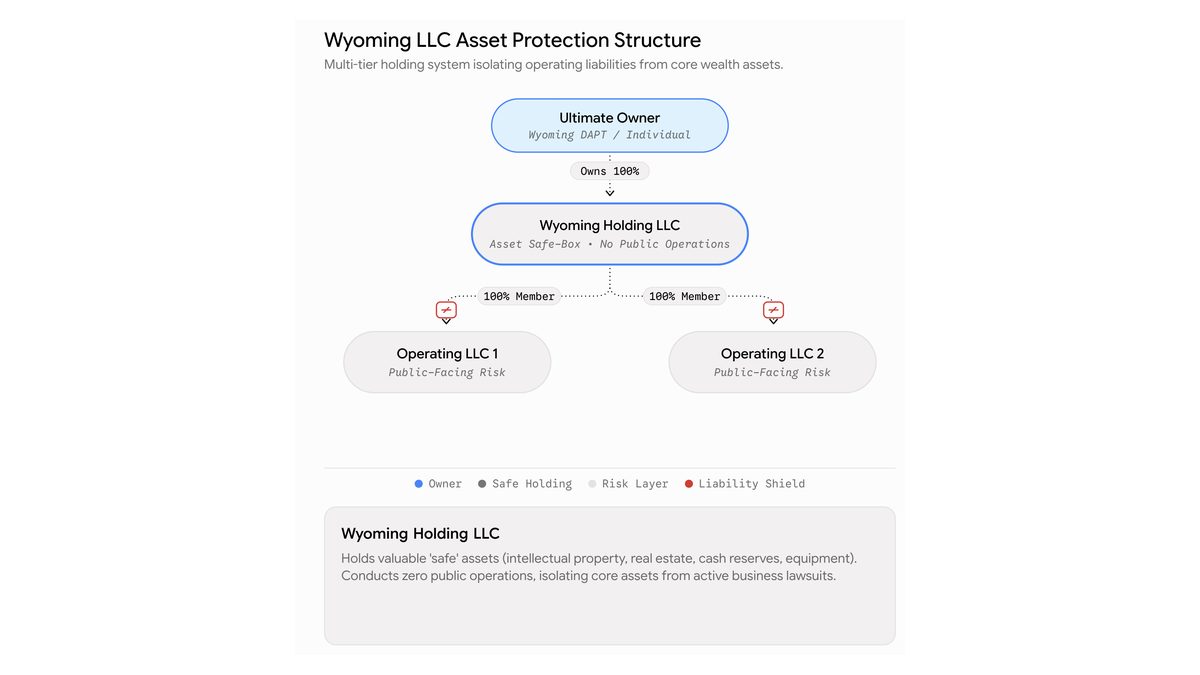
A Wyoming LLC can act as a holding company: a parent entity that owns valuable assets, ownership interests, intellectual property, cash reserves, equipment, or subsidiary LLC interests instead of running the public-facing business itself. The idea is simple. Put safer assets in the parent layer and put daily business risk in separate operating entities.
That is the strategy people mean when they say wealthy families and serious operators use entities to protect assets. It is less about secrecy and more about risk separation. The structure only works if the entities are formed correctly, funded correctly, insured appropriately, documented with strong agreements, and operated as separate companies.
Is a Wyoming LLC holding company anonymous?
No. A Wyoming LLC may give public-record privacy because the public state filing does not need to show every owner the way some people expect, but privacy is not anonymity. The company still needs a registered agent, internal ownership records, tax records, banking records, and a real responsible party for an EIN.
Wyoming's Secretary of State explains that all businesses must continuously maintain a registered agent with a physical Wyoming address, and that registered agents keep specified records for domestic entities. The IRS also says the responsible party for an EIN is the person who ultimately owns, controls, or effectively controls the entity; nominees should not be listed as the responsible party. See the IRS responsible-party guidance before assuming an organizer, agent, or nominee can stand in for the actual owner.
| Question | Practical answer |
|---|---|
| Are all owners necessarily shown on the public state filing? | Often no, but the LLC still needs accurate internal ownership records. |
| Can a registered agent hide the real owner from banks or tax records? | No. Banks, the IRS, contracts, and advisers may require control and ownership information. |
| Does Wyoming privacy replace good records? | No. Privacy is strongest when records are accurate, organized, and consistent. |
| Does the Corporate Transparency Act currently require U.S. companies to file BOI reports with FinCEN? | FinCEN states that U.S. companies and U.S. persons are not currently required to report beneficial ownership information under the current rule posture. |
Use Wyoming privacy as a public-record feature, not as a plan to conceal control from tax, banking, court, or compliance systems.
What assets belong in the holding LLC?
A holding company is most useful when it owns assets that should not sit directly inside the operating company that deals with customers, employees, vendors, tenants, jobsites, vehicles, products, or other public-facing risk. The parent may hold cash reserves, intellectual property, equipment, real estate interests, member interests in subsidiaries, or other strategic assets.
The key discipline is that the parent LLC should not run the dangerous business. If the same company holds the valuable assets and signs the risky customer contracts, the structure is doing less work. The operating LLC should carry the contracts, employees, insurance, revenue activity, and public-facing obligations for that business line.
- Good holding-company assets may include subsidiary ownership interests, intellectual property, cash reserves, equipment leased to an operating company, or real estate held separately from the operating business.
- Risk-layer assets usually belong in the operating LLC that signs customer contracts, hires workers, accepts revenue, carries trade debt, manages public operations, and holds the relevant insurance.
- Do not mix roles by letting the parent sign ordinary customer contracts, borrow for unrelated operating activity, pay the subsidiary's bills without documentation, or use one bank account for multiple companies.
- Coordinate with advisers before moving real estate, regulated assets, pledged collateral, financed property, securities, retirement assets, or assets already exposed to creditor claims.
How does the parent-subsidiary structure help protect assets?
The structure is built around direction of risk. If Operating LLC 1 is sued over its own public-facing business, the goal is for that claim to stay at Operating LLC 1 instead of jumping automatically to the Wyoming holding LLC or to Operating LLC 2. If Operating LLC 2 has a separate claim, the same logic applies in the other direction.
This is where Wyoming's LLC law is often attractive. The Wyoming LLC Act includes charging-order language for a judgment creditor of a member, and Wyoming is frequently discussed for that reason. But charging-order protection is not the same as lawsuit immunity. It generally concerns a creditor's remedy against a member's transferable interest; it does not make bad records, fraud, undercapitalization, personal guarantees, tax debts, fraudulent transfers, or direct company liabilities disappear.
| Risk source | Why the structure helps |
|---|---|
| Customer, vendor, employee, or premises claim against an operating LLC | The claim should begin with the operating company that created the exposure, not the asset-holding parent. |
| Creditor of an owner or member | Wyoming charging-order rules may limit the remedy against the member's LLC interest, subject to facts and applicable law. |
| Debt guaranteed personally by the owner | The entity structure usually does not protect the owner from a personal guarantee. |
| Debt, tax, tort, or contract liability of the holding LLC itself | Inside liability still stays inside the entity that created the obligation; do not let the parent create avoidable operating risk. |
| Transfers made after a claim or creditor problem appears | Entity planning should happen early. Do not move assets after a claim appears without legal advice. |
The structure can help separate risk, but timing, documentation, capitalization, insurance, and real-world conduct matter.
Does forming in Wyoming mean you can ignore your home state?
No. Wyoming does not erase operating-state compliance. If your operating business is actually run in California, Texas, Florida, New York, Illinois, or another state, that operating company may still need foreign qualification, state tax registrations, licenses, payroll accounts, sales tax permits, local permits, or industry-specific filings where it does business.
The parent holding LLC may have fewer public-facing activities, but that does not mean there are no obligations. A holding company still needs formation records, a registered agent, annual compliance, tax classification coordination, accurate books, and agreements with the subsidiaries it owns or supports. Start with the LLC formation guide, then connect the structure to the LLC operating agreement guide so ownership and authority are clear.
What tax treatment should a Wyoming holding LLC expect?
Wyoming is popular partly because it has no state individual income tax, but federal tax classification still matters. The IRS explains that a domestic LLC with one member is generally disregarded for federal income tax unless it elects corporate treatment, and an LLC with at least two members is generally classified as a partnership unless it elects otherwise. Treasury regulations under Section 301.7701-3 govern those entity-classification choices.
For a holding company, this can affect how income, deductions, depreciation, management fees, rents, royalties, intercompany payments, and sale proceeds are reported. Tax treatment also depends on the owner, the subsidiaries, the assets, and where business activity actually happens. Use a CPA before building the structure around tax assumptions.
How do you set up a Wyoming holding company correctly?
The paperwork is only the beginning. Asset protection is a system. The structure needs formation documents, ownership records, operating agreements, bank accounts, tax setup, intercompany agreements, insurance, bookkeeping, and ongoing compliance that all tell the same story.
- Decide what the parent holding LLC will own and what each operating LLC will do.
- Form the Wyoming parent LLC and appoint a qualified Wyoming registered agent.
- Create operating LLCs for public-facing business lines, real estate projects, products, or risk centers when separation is justified.
- Write operating agreements that identify owners, managers, capital, voting, transfers, subsidiary ownership, and intercompany authority.
- Open separate bank accounts and bookkeeping for every entity; separate books and bank accounts are not optional if the structure is meant to work.
- Document leases, licenses, management fees, loans, contributions, asset transfers, and service arrangements between entities.
- Confirm EIN responsible-party reporting, tax classification, foreign qualification, state registrations, insurance, and annual compliance calendars.
- Store signed agreements, approvals, ownership charts, filings, tax records, and annual reports in one organized company record.
What mistakes weaken a Wyoming LLC structure?
The most common mistake is treating the structure like a filing trick. A court, lender, buyer, insurer, taxing authority, or opposing party will look at what actually happened. Did the companies have separate accounts? Were transfers documented? Did each company have enough capital and insurance for its role? Did the owner sign personally? Were contracts in the right company name?
- Using one bank account for the parent and subsidiaries.
- Letting the parent holding LLC sign routine customer contracts or employ the workers who create operating risk.
- Transferring valuable assets without a written agreement, valuation support, tax review, or lien review.
- Assuming Wyoming formation avoids foreign qualification or taxes in the state where the business actually operates.
- Listing a nominee or formation helper as the EIN responsible party instead of the person who ultimately controls the entity.
- Ignoring insurance because an LLC exists.
- Moving assets after a dispute, lawsuit, creditor demand, tax issue, divorce, guarantee call, or insolvency concern appears.
- Failing to update the operating agreement when owners, managers, assets, subsidiaries, or tax treatment changes.
How does EntityEngine help keep the structure clean?
The wealthy do not just file LLCs. They keep records. EntityEngine is built for that operating layer: the facts, documents, approvals, reminders, ownership relationships, and company records that let a structure stay understandable after formation.
Use EntityEngine formation to start the Wyoming parent holding company and related LLCs, then use Corporate Records and the EntityEngine platform to keep operating agreements, ownership charts, subsidiary records, annual reports, EIN records, and compliance tasks connected. The goal is to document the structure before money moves, not reconstruct it after a problem.