
Build the evidence as you go, not after the buyer calls
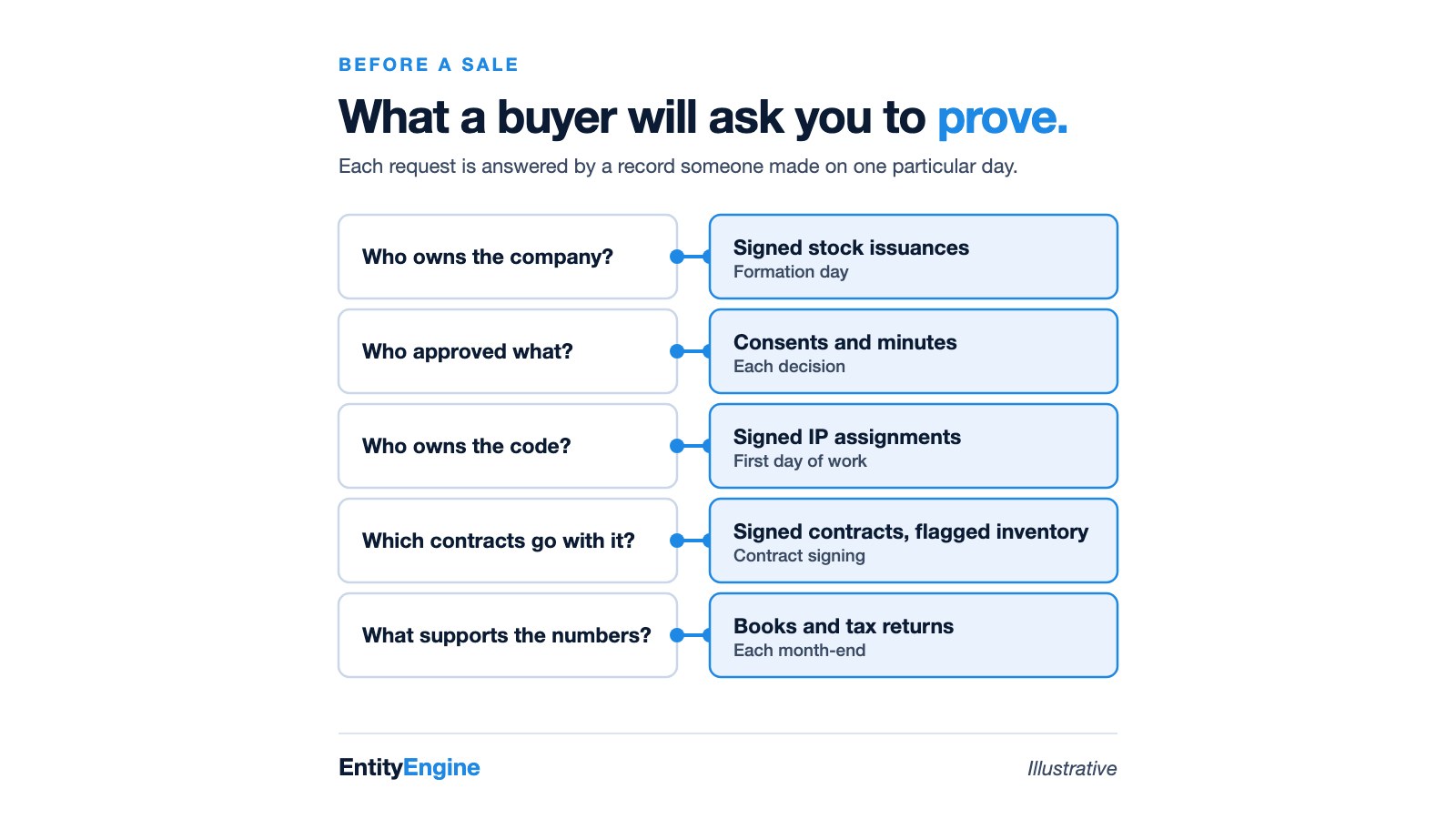
Around the time you sign a letter of intent, a buyer's lawyer often sends a request list. It asks you to prove five things: who owns the company, who approved what, who owns the code, which contracts go with the company, and what supports the numbers. Add one easy-to-miss tax deadline, the 83(b) election. Each answer is a record someone made on a specific day, from formation onward. Make it that day and the list is mostly gathering; skip it and someone pieces it together while the buyer waits. That is what it takes to prepare your company for a future sale: make each record on the day it matters.
This post is general education, not legal or tax advice. Sources checked on October 2, 2026. Statutes and thresholds change, so confirm the current text with your attorney or CPA.
The stock ledger, approval, and ratification examples here are for Delaware corporations; LLCs and other states follow their own rules, so for an LLC start with your operating agreement and member records. The tax, IP, and merger-review points are federal and apply more broadly. Your corporate records are the evidence behind every answer.
Where you are decides how to use this list:
- Forming now: use this as your day-one list.
- Already running: jump to the catch-up order near the end, and start with the four in "Do these first".
- A buyer is already at the table: hand this list to your transaction lawyer and CPA, and let them lead.
Do these first. If you only have an afternoon, start with the four items that depend on a date or a signature: the 83(b) window (if your founder stock vests), signed IP assignments, how your stock was first issued, and board actions nobody wrote down.
The first request list asks for records you created years earlier
Hypothetical, not a customer story. A founder formed a Delaware C corporation four years ago and has just signed a letter of intent, the short document that sets out the buyer's proposed terms. The buyer's lawyer replies with a due diligence list (the buyer's check that the company is what the seller says it is). It asks for:
- A current owner list and the signed documents behind each stock issuance.
- Board and stockholder approvals for issuances, major contracts, and the deal.
- Proof the company owns its software and other IP, with signed assignments.
- Material contracts with every amendment, and which ones need the other side's consent.
- Financial statements and tax returns, with the support behind them.
In this made-up company, the owner list and financials go out quickly. Two items do not. An early contractor wrote the first version of the product and never signed anything about who owns it, and one large customer contract may need the customer's consent if the company changes hands. Nobody wrote either problem down, so the founder, a lawyer, and a CPA piece the facts together while the buyer waits. No public data shows how often a gap like this changes a price or ends a deal, so treat this as an illustration, not a forecast.
| The request | The record that answers it | Make it when | Can it be fixed later? |
|---|---|---|---|
| Who owns the company? | Formation documents, signed issuances, a matching ledger | Formation day, then each issuance, grant, or raise | Sometimes. Counsel checks that the records agree; some defects need a formal fix |
| Who approved what? | Board and owner consents, minutes, officer roster | The day of each decision | Sometimes. Delaware has a formal ratification path (approving a defective act after the fact) |
| Who owns the code? | Signed assignments from everyone who built it | Before work starts: formation day, each hire or contractor | May be fixable by signature, if the person agrees |
| Which contracts go with the company? | Signed contracts, every amendment, a flagged inventory | First customer contract and each one after | Not a records fix. Counsel reads flagged clauses; consent may be needed |
| What supports the numbers? | Monthly books, tax returns, debt support | Each month-end and year-end | Partly. Your CPA rebuilds the support while the buyer waits |
| Which tax elections were made on time? | The filed election and proof of filing, if one applied | Inside the election deadline (83(b): 30 days) | Usually no. A missed 83(b) date is not fixable later |
The third column is the point. A buyer asks for these years later, but each record is made on a particular day.
The owner list has to match the signed documents behind it
What the buyer asks. A current list of owners with share counts, copies of every signed issuance, any SAFEs and convertible notes (early investments that turn into stock later), or option grants (promises of future stock), and an entity chart showing which company holds the business.
In Delaware, the stock ledger is the only evidence of who may vote at a stockholder meeting or inspect the stockholder list (8 Del. C. 219 and 224). A ledger lists each stockholder, the shares each one holds, and each issuance and transfer. That rule covers voting and the stockholder list, not proof of ownership for every purpose, so a buyer reads the signed documents too.
An LLC has no stock ledger. Its operating agreement sets the rules for transfers, approvals, and a sale, and its member records show who owns what. Check that the records match who actually owns the company and that each change of owner was approved the way the agreement requires. If the agreement is missing or out of date, fix that first.
Two other points differ for LLCs. The ratification process in sections 204 and 205 covers Delaware corporations; the Delaware LLC Act has its own rule, 6 Del. C. 18-106(e), which counsel applies with your operating agreement. And QSBS needs C corporation stock, so an LLC taxed as a partnership does not qualify. Whether an LLC that elects corporate tax treatment or converts can is a question for tax counsel. Ask your attorney who keeps the ownership record.
When to create it. At formation, when the founder stock is authorized and issued with signed paper. Then again at each issuance, grant, transfer, or raise. States set their own recurring filings and fees, such as annual reports and franchise or annual taxes, that can affect good standing (the state's record that you have filed what it requires).
One step has a clock. An 83(b) election is a choice to be taxed on restricted stock when you receive it, on any value above what you paid, instead of as it vests.
If founder stock vests over time and was transferred in connection with the founder's work for the company, even if the founder paid for it, the IRS generally gives 30 days from the transfer to decide on an 83(b) election. The deadline is in the tax code and the IRS form offers no late option, so a missed date generally is not fixable later. The founder who received the stock files the election and gives the company a copy; the company does not file it for you. The election is voluntary and not needed for every grant; whether to file is for you and your CPA.
QSBS, or qualified small business stock, is a federal tax break for some C corporation stock. It depends on facts about the company, the stock, and the holder, some of them set when the stock is issued, and the rules differ for stock acquired on or before July 4, 2025 and after it. Forming a Delaware C corporation does not by itself make stock qualify, so ask tax counsel. Our QSBS guide has more.
Check now:
- Find the signed stock purchase or issuance document for each owner, and match it to your owner list.
- Confirm the date of each founder stock transfer and, if the stock vests, whether an 83(b) election was filed within 30 days.
- Look up each entity's current status with its state.
- Write down the date and source of each stock issuance, and ask tax counsel whether QSBS rules could apply, since they differ for stock acquired on or before and after July 4, 2025.
Who approved what depends on how the deal is built
What the buyer asks. Approvals for each issuance, major contract, and financing, and later for the sale itself, with the consents and minutes behind them. A consent is a signed approval given without a meeting. The buyer also reads the charter (the document filed with the state that creates the company), bylaws, and any stockholder agreement, which can add approvals, such as a higher-than-majority vote or a separate vote by preferred stockholders. A stockholder agreement may also include drag-along rights, which let a group of owners, as that agreement defines it, require the others to join a sale.
In a 2005 merger agreement (the SEC-filed Qualcomm and Flarion deal, a public company buying a private startup), the startup promised that its minute books were a materially complete and accurate summary of its board and stockholder meetings and written consents since incorporation.
Which approvals matter depends on how the deal is built, and not every sale needs a merger resolution. For a Delaware corporation, the three common forms work like this.
- Merger. When two Delaware corporations merge, each board approves the merger agreement, and each company's stockholders generally approve it too, by a majority of the outstanding shares entitled to vote unless the charter asks for more. Exceptions exist, and stockholders who do not vote for a merger can have appraisal rights, so counsel plans for that (8 Del. C. 251, 253, and 262).
- Sale of all or substantially all assets. The board decides the terms, then holders of a majority of the outstanding voting stock authorize the sale (8 Del. C. 271). What counts as "all or substantially all" is a question for counsel.
- Stock sale. The buyer signs a contract with each selling stockholder, so what matters first is each stockholder's own agreement and any transfer restrictions in the charter, bylaws, or a stockholder agreement (8 Del. C. 202). A buyer who wants every share needs every holder to agree, or a drag-along right or a merger to bring the rest along, and the board may still need to act on transfer restrictions. Counsel tells you what applies to your deal.
When to create it. On the day of each decision, in writing. Informal or backdated paperwork does not make an unauthorized decision timely. For a Delaware corporation, only the formal ratification route can, and counsel decides whether it fits.
For Delaware corporations there is a formal route to ratify a defective corporate act or defective stock (8 Del. C. 204 and 205). The board adopts resolutions, stockholders approve where the statute requires it, and sometimes the Court of Chancery, Delaware's business court, gets involved. Counsel leads it. It is not a casual change of dates, and it does not cure everything.
Check now:
- List the major decisions since formation, such as stock issuances, financings, and large contracts, and find the written approval for each.
- Read your charter, bylaws, and any stockholder agreement for approval, transfer, and sale terms.
- Check that your officer and director roster matches who holds those roles.
Owning the code takes a signed paper, not a handshake
What the buyer asks. Proof that the company owns its intellectual property (IP), meaning software, designs, content, brand names, and inventions, with signed assignments from every founder, employee, and contractor who made it. The buyer also wants a list of the patents, trademarks, and open-source code you use.
By default, the person who creates a work owns the copyright (17 U.S.C. 201). For copyright, a company owns what its employees make as part of their jobs. For a freelancer, the company owns the work only if it fits one of nine listed categories and both sides signed a work-made-for-hire agreement (the definition in section 101). Otherwise the freelancer has to sign a written assignment (17 U.S.C. 204). Employee or contractor follows the facts, not the label (Community for Creative Non-Violence v. Reid).
Inventions work differently. Patent rights generally start with the inventor, so founders and employees also sign invention assignments. Courts can treat an employee hired to invent differently, and an employer may keep a limited right to use an invention without owning it, so ask an IP attorney.
A patent or patent application is assigned by a written instrument (35 U.S.C. 261), which in practice the person assigning signs. Transfers that happen automatically, as in a merger, are a separate matter for counsel. Recording that document with the USPTO gives the public notice and protects the buyer against a later purchaser who had none. The USPTO treats recording as a clerical step and does not check that the transfer is valid (MPEP 301).
In the 2005 Qualcomm and Flarion merger agreement, the startup promised that employees who contributed to its IP had signed agreements assigning it to the company. That was one deal's negotiated promise, not a rule.
When to create it. Before the work starts. For founders, that means at formation: the founder assigns to the company what the business depends on. For each hire and contractor, it means the first day of work. If it was missed, a signed assignment may still be obtainable, if the person agrees and an IP attorney drafts it. Until it is signed, ownership may not have passed to the company, and the company's right to keep using the work may be limited, so counsel handles the approach. A later assignment passes only what the person still owns, and a founder's earlier employer or university may have claims on earlier work, so counsel checks.
Check now:
- List everyone who wrote code, made designs, or created content, and find a signed assignment for each person.
- If you hold patents, search USPTO Assignment Search for each one and note any gap (a missing record is not proof that no transfer happened).
- List the open-source code in your product and the license each piece carries.
Contracts that go with the company need a list and a lawyer's read
What the buyer asks. Complete copies of material contracts with every amendment, and a note of which ones need the other side's consent, can be ended, or carry exclusivity when the company changes hands.
That means executed agreements in one indexed place, plus an inventory of customer, supplier, lender, lease, license, employment, and investor agreements, with an owner for each. Flag assignment, change-of-control, termination, consent, and exclusivity terms. A change-of-control clause gives the other side a right, such as consent, termination, or a fee, when the company changes hands. Its wording sets the trigger, which can differ between an asset sale, a stock sale, and a merger, so a lawyer reads it.
In the 2005 Qualcomm and Flarion merger agreement, the startup had to list its material contracts, hand over complete copies with all amendments, and confirm which ones needed the other side's consent. Those were that deal's negotiated terms, not law and not a universal checklist.
When to create it. When each contract is signed: save the executed copy and every amendment. Then review the inventory on a schedule. If you missed it, a lawyer reviews the flagged clauses, and the other side's consent may be needed.
Check now:
- Gather the signed copy, with every amendment, of your largest customer, supplier, lender, and lease contracts.
- Mark any clause about assignment, change of control, termination, consent, or exclusivity, and send those to your lawyer.
Financial support is the part your CPA owns
What the buyer asks. Financial statements, tax returns, a debt schedule, customer and revenue support, and working-capital records.
These should reconcile, meaning agree with each other and with what management says. That takes a monthly close (the books finished and reviewed each month), filed tax returns, and support for debt and working capital. When a sale is in view, ask your CPA about a quality-of-earnings review, an outside check of how reliable reported earnings are.
When to create it. Every month and every tax year. Keep every month's books closed and every return filed; your CPA tells you how long to keep support.
Check now:
- Ask your CPA whether monthly financials, tax returns, and debt balances reconcile to each other.
- Ask what a quality-of-earnings review of your numbers would look for.
Can you fix a missing record after the buyer asks?
Sometimes. Some gaps are fixed with a signature, some need a formal Delaware process, some need counsel to find out what is wrong first, and a few generally stay missed.
- Fix by signing. A missing IP assignment from a founder, employee, or contractor, if the person agrees and an attorney drafts it.
- Fix by a formal process. A defective corporate act or defective stock in a Delaware corporation can be ratified by the board and, where the statute requires it, the stockholders (8 Del. C. 204) or validated by the Court of Chancery (205). Counsel leads it.
- Needs counsel first. A ledger that does not match the signed documents needs counsel to find out which one is right. A ledger edit will not fix shares that were never validly issued. Do not rewrite the ledger to match.
- Usually stays missed. A missed 83(b) election. The 30-day window is statutory (26 U.S.C. 83(b)), and we found no late-election procedure. If you missed it, ask a CPA what that means for tax as the stock vests; do not backdate anything. Some QSBS facts are fixed by what actually happened, such as when the stock was acquired and whether it came straight from the company (original issue). Ask a tax adviser; this post does not say whether any stock qualifies.
So can a lawyer or CPA assemble the file after a buyer appears? Yes, when the records exist. An adviser does not change a past ownership event. Informal or backdated paperwork does not make an unauthorized decision timely; for a Delaware corporation, only the formal ratification route can.
Do organized records make a sale faster or higher-priced?
Not on their own. We found no study that measures this for small U.S. private-company sales.
The closest evidence is a 2025 study of 1,286 acquisitions of private European companies announced from 2012 to 2023. Deals closed faster when the target's financial reporting was stronger, measured by indicators such as accounting-estimate quality and whether auditors gave a qualified opinion (Gill-de-Albornoz, Maffei, and Spagnuolo). In that sample, the median deal took 95 days from announcement to completion; the average was about 202.
Read it carefully. It covers the EU and the UK, only deals that completed, and an average deal of about EUR 216 million, far larger than a typical small founder sale. It measures financial statements, not ownership, board, or contract records, and it shows an association, not a cause. Do not read 95 or 202 days as a closing time to expect.
Price is less clear. A study of U.S. publicly listed deals from 1985 to 2022 found that targets with more conservative accounting were associated with lower takeover premiums, but only where it was hard to judge the target's value (Elgendi, Akbar, and Khalil, published online May 6, 2026). Those were listed companies, so the study does not show what happens to a private seller. Cleaner reporting does not automatically mean a higher price.
Records reduce avoidable uncertainty. They do not create earnings, set value, or guarantee a buyer.
Records do not clear a regulator, find financing, or settle a price
In KPMG's 2025 study of the deal market, 300 U.S. M&A (mergers and acquisitions) professionals named completing due diligence (41%) as a top challenge to closing recent deals. Valuation (44%) and regulatory hurdles (41%) ranked alongside it, and financing challenges (53%) were listed separately. That is what dealmakers say got in the way, not the share of deals that failed. It does not say missing corporate records caused the diligence challenge, and it is not about small private-company sellers (KPMG, report dated February 2025).
If a deal meets the filing tests of the Hart-Scott-Rodino (HSR) Act, in most cases both sides file with the FTC and the Justice Department. They generally must wait to close until a 30-day waiting period ends or is cut short (FTC guide, 15 U.S.C. 18a). The 30 days count from when the agencies receive completed filings, not from signing. A request for more information extends them.
For closings on or after February 17, 2026, and until the next annual adjustment, the basic size-of-transaction line is $133.9 million (FTC). The FTC adjusts the lines every year, and other tests and exemptions apply, so the number alone does not tell you whether a filing is required. The filing form has also been in legal flux in 2026 (FTC forms page); confirm current requirements with counsel.
Regulatory review can also end a signed deal. In December 2023, Adobe and Figma agreed to call off their merger after concluding there was no clear path to approval from the European Commission and the UK Competition and Markets Authority. Adobe agreed to pay Figma a $1 billion termination fee (Adobe Form 8-K). It says nothing about recordkeeping, and organizing documents does not solve a competition concern.
Financing, buyer strategy, and disagreement over value also sit outside your records. Records answer "is the company what you said it is?" They do not answer "is it worth that?"
What a record layer holds, and what your professionals handle
EntityEngine is a place to organize the company record layer: formation documents, governing documents, board minutes, recurring state deadlines, and company documents. On plans that include it, its Compliance Engine keeps recurring state deadlines, such as an annual report or franchise tax, on a calendar and reminds you before they are due. Company documents live in a folder-organized vault with role-based access.
A record layer, not the deal. EntityEngine does not replace your attorney, CPA, or banker. It is not a law firm, does not give legal or tax advice, and does not run a deal. Financial quality, deal structure, buyer competition, and regulatory review still decide a deal.
| Part of the record | EntityEngine can help organize | Your professionals handle |
|---|---|---|
| Entity and formation | Formation and governing documents, kept together | Attorney and tax adviser choose and confirm the structure |
| Decisions and approvals | Board minutes can be filed to the vault | Attorney decides the approval path for the deal |
| Ownership | Not an ownership record. Signed issuance documents can be filed with other company documents | Attorney or equity administrator keeps and reconciles the ledger; tax counsel handles 83(b) and QSBS questions |
| IP and contracts | Signed assignments and executed contracts, kept in the vault | IP attorney checks ownership; transaction counsel reads consent terms |
| Compliance | Recurring state deadlines on a calendar, with reminders | Corporate counsel confirms good standing and licenses |
| Finance and the deal | Not a finance tool. Supporting documents you choose to file | CPA, banker, and counsel run the numbers, the data room (the online folder where sellers share documents with the buyer), and the process |
EntityEngine does not guarantee a sale, a faster close, or a tax result. Whatever tool holds your ownership list, the signed documents are what a buyer reads.
How to prepare your company for a sale: build the record in this order
Who usually owns each step is in parentheses. For the first-year corporate file, see our solo founder guide.
- Draw the entity and ownership map, and confirm each entity's formation and current status with its state. (Founder, with counsel)
- Reconcile owners to the governing documents, approvals, signed issuances, and the ledger. Send any mismatch to counsel. (Counsel)
- Keep formation documents, bylaws or operating agreement, approvals, minutes, and tax elections in one indexed set. (Founder)
- Name the owner of each important IP asset and find the signed assignments. (IP attorney)
- List material contracts and flag assignment, change-of-control, termination, consent, and exclusivity terms. (Founder, then counsel)
- Ask for reliable monthly reporting, tax returns, and debt and working-capital support. (CPA)
- Before you approach buyers, work with transaction counsel, a CPA, and where it fits an M&A adviser. (Counsel, CPA, adviser)
Already running? Catch up in this order, and hand a live deal to professionals
If your company is already running, treat the same list as an audit. Make a one-page inventory for each request: where the record is, who owns it, when it was last checked, and whether a professional should look. Ask counsel to draft what a signature can fix, send the rest to counsel too, and do not backdate anything.
Work the inventory in this order. Steps 1 to 4 are the records that depend on a date or a signature; step 5 adds the contracts:
- Check whether you filed an 83(b) election in time for any vesting founder stock. If the 30-day window passed, tell your tax adviser; do not fix it yourself.
- Find a signed IP assignment from every founder, employee, and contractor who built your product. Missing ones go to an IP attorney; do not backdate.
- Match your owner list to the signed documents behind each stock issuance. Send any mismatch to counsel.
- Look for a written approval for each big decision (issuances, major contracts, officer and director changes). Where none exists, ask counsel before writing one after the fact.
- Flag consent and change-of-control terms in your largest contracts and have counsel read them.
If a buyer is already at the table, with a letter of intent signed or terms under negotiation, do not run this yourself. That stage needs a professional-led diligence sprint with transaction counsel and a CPA. Use this list to brief them.
After the catch-up, work forward from your next event, not the whole file. Each of these moments creates a record:
- Formation day: formation documents, bylaws, founder stock, a founder IP assignment, and, if the stock vests, a decision on an 83(b) election within 30 days of the transfer.
- First hire or contractor: a signed IP assignment before the work starts.
- First customer contract: a signed copy, every amendment, and a flag for consent and change-of-control terms.
- Each stock issuance to a founder or team member: board approval, signed issuance documents, an updated owner list, and, if the stock is subject to vesting and was transferred for work, a new 83(b) deadline 30 days after that transfer (options and RSUs generally cannot use 83(b); ask your CPA about early exercise).
- Each year: state annual report and franchise or annual tax by your state's due date, tax returns by their due dates, and a check that your inventory still matches.
Readiness is the record you build along the way, so the best day to make each record is the day it happens.